When you share your event online, the free advertising it provides can lead to explosive ticket sales. That’s because posting your event on multiple websites increases the chances that someone will see it. Every post can drive word-of-mouth marketing, more traffic to your ticket sales page, and more ticket sales. It really is that simple.
The question truly isn’t why should you post your event on multiple websites, but rather, why wouldn’t you? The benefits to share your event online far outweigh the small amount of time it takes to add your event to a handful of targeted sites where your prospective ticket buyer audience can find it.
Please note AttendStar does not list events that we do not ticket also.
Whether you’re planning a music festival with rock music, a Christian concert, a play, or a business conference, there are sites where people are actively looking for events like yours. Your event needs to be there!
To save you the time it would take to find these event listing sites, below is a list of 15 great options. If you visit Google and search for “submit your event” or “post your event,” you’ll get a long list of articles filled with options — many of which are duplicates that you’ll need to sift through. Don’t feel like you have to post your event on every site to move the ticket sales needle. Choose the sites that are most relevant to your event and your audience.
Once you’ve listed your event across multiple event sharing sites, be sure to watch your Google Analytics reports to see where the traffic to your ticket sales page is coming from. Some of the event sharing sites listed below might perform much better than others, which will save you time when you need to promote another event in the future. You’ll know which sites to focus your efforts on next time.
With that said, here’s the list of 15 sites where you can get free advertising by sharing your event online:
1. Best Places to Share Your Event Online
Eventful lists a wide variety of events and even syndicates events to other websites to give your event more exposure.
2. Yelp
Yelp began as a local business directory, but it’s so much today. It includes an events section for most cities where you can submit your event whether it’s a music event, art event, business event, non-profit event, or something else.
3. Eventcrazy
Eventcrazy is “America’s search engine for fun things to do.” It just takes a few minutes to submit your event to the list.
4. YourEventFree.com
YourEventFree.com is a directory of events where you can quickly add your own event. There is a long list of categories to choose from.
Social Media and Forum Sites
5. Facebook Event Page
You can easily add an event to your Facebook Page so you can share it and promote it to your Facebook Page fans and the larger Facebook community of over 1 billion daily users.
6. Online Forums
Online forums are usually targeted to specific interests, so it makes sense to share your event with audiences who have already shown an interest in your event performers or speakers by joining related forums. If you’re not aware of online forums that are relevant to your event, Google a keyword related to your event plus the word “forum” to find some.
7. Facebook Groups
Are there any Facebook Groups related to your event? They’re a perfect place to share your event, so go ahead and start searching for them if you don’t already know some. Here’s a great write-up that will teach you how to find and join Facebook Groups.
8. LinkedIn Groups
For business-related events, LinkedIn Groups can be a much more effective way to share your event than Facebook Groups. Just search for relevant LinkedIn Groups, join them, and share your event.
Local Sites
9. Craigslist
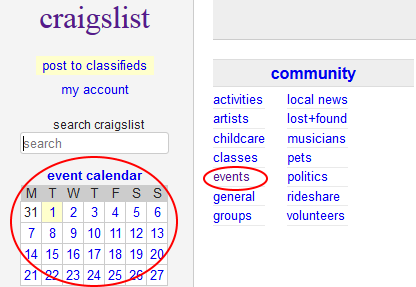
Craigslist is known as the local selling site where people can sell just about anything, but did you know it also includes an event section? Just post your event to the local Craigslist where the event will be held. “Events” is listed under the “Community” section on the local Craigslist page. Your event will appear here when people click on “Events” or on the “Event Calendar” in the right sidebar – see the image below.
10. Eventseeker
Eventseeker is owned by Cityseeker, which provides information about accommodations, restaurants, attractions, nightlife, shopping, and tours for a long list of cities in the U.S. Local events are listed on the Eventseeker site, and you can add your event, too.
Business Sites
11. All Conferences Alert
All Conferences Alert is a global online conference directory with over 100,000 conferences, expos, trade shows, seminars, and exhibits listed. Your event doesn’t have to be about business to be included here, but it should be targeted to a business-oriented audience. For example, the event could be related to art, medicine, technology, recreation, science, health, and more.
12. Lanyrd
Lanyrd is a social conference directory where you can list any professional or hobbyist event targeted at knowledge-sharing. The event should either have at least one speaker or be a professional networking event such as a conference, unconference, workshop, seminar, convention, trade show, and so on.
13. American City Business Journal Sites
The American City Business Journal publishes business-related websites for a variety of cities across the United States. Each site includes an events section where you can submit your event. For example, click the following link to view the Orlando Business Journal events page. From your city’s event page, simply click the Add Your Event button to submit your event.
14. City Crain’s Site
Crain’s Communications, Inc. publishes city-specific websites for the business sector, and many of those sites (but not all) include events sections. Just find your city’s site, and submit your event. For example, the following link shows you the local event listings from the Crain’s Detroit Business site.
Your Next Steps to Share Your Event Online
When it’s time to promote your event, don’t focus all of your energy on paid promotion tactics. Simply sharing your event across the web can boost ticket sales if you’re willing to invest a few minutes per site to submit your listing. The key is to focus on the sites where your audience is most likely to spend time.
The first time you submit an event to these sites will take the longest because you’ll have to create some new accounts in order to log in and add content. However, once you set up your accounts, sharing future events will be so much faster!
Please note: We do not list events on our website that we do not do ticketing for.