
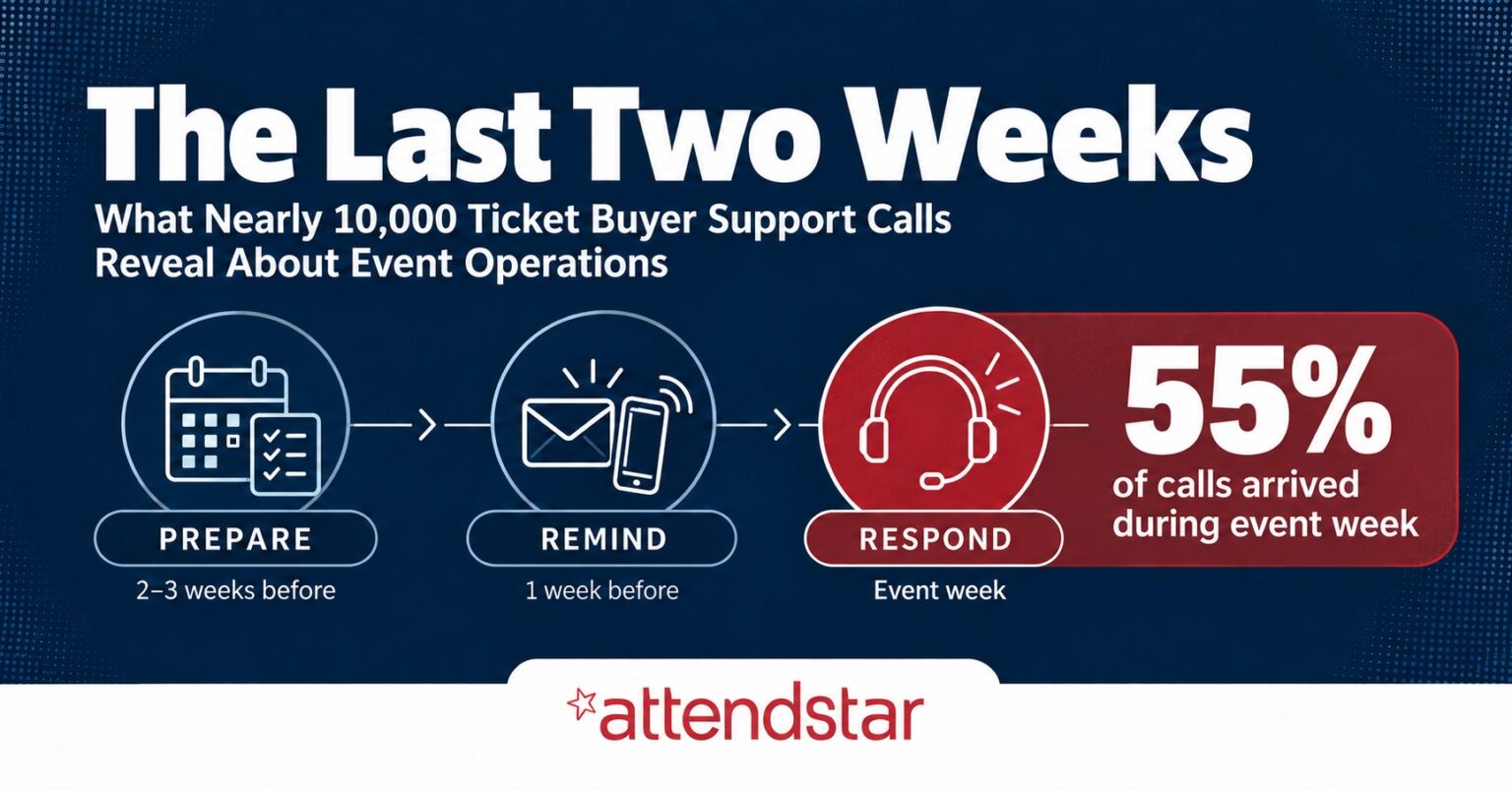
Most ticket buyer questions do not arrive during the long sales cycle. They arrive when event teams have the least time to answer them.
Months of planning go into producing a successful outdoor event. Then event week arrives, and the pressure changes almost overnight.
The operations team is coordinating vendors, volunteers, parking, security, weather plans, entrances, production schedules, and dozens of last-minute details. At the same time, ticket buyers begin reaching out with questions:
- Where can I find my tickets?
- Which entrance should I use?
- Is parking included?
- Can I buy tickets at the gate?
- What happens if it rains?
- What can I bring?
- Where is accessible parking?
- Does my child need a ticket?
- What time should I arrive?
None of these questions is unusual. The challenge is that they often arrive at the same time.
An AttendStar analysis of 9,919 ticket buyer support calls across 10 outdoor events found that support demand was not evenly distributed throughout the sales cycle. It was heavily concentrated near the event itself, especially during event week.
That finding has an important operational implication: ticket buyer communication should not be treated only as customer service or marketing. It should be planned as part of event-day readiness.
The Essential Takeaway
54.5% of all calls arrived during event week. Plan attendee communication, current event information, and human support as part of operational readiness.
What the Data Shows
Across the 10 large outdoor events studied:
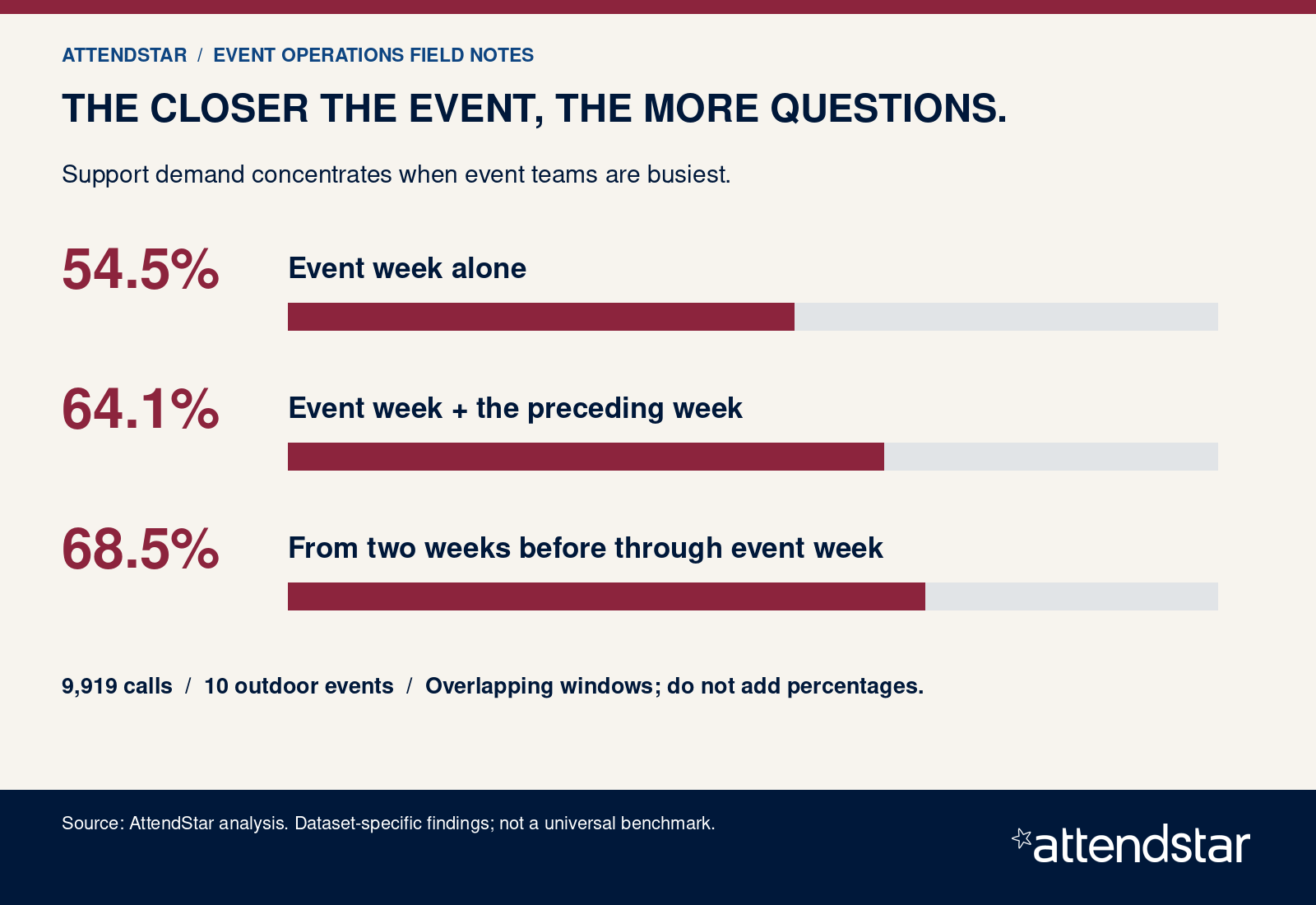
- 54.5% of all ticket buyer support calls occurred during event week.
- 64.1% occurred during event week or the week immediately before it.
- 68.5% occurred from two weeks before the event through event week.
- 8 of the 10 events received a majority of their support calls during event week alone.
- The median event received 63.4% of its total support volume during event week.
- 7 of 10 events received at least 70% of their calls within the final two-week window.
The median is especially useful here. It describes the middle event in the dataset and is less affected by differences in event size. For that typical event, nearly two-thirds of all ticket buyer support calls arrived during event week.
The overall pattern can be summarized simply: The closer an event gets, the more ticket buyers begin actively engaging with the details of attending—and the more help they need.
The exact percentages will vary by event type, attendance, weather, ticket complexity, parking procedures, promotional timing, and the quality of attendee communication. However, the broader pattern is clear: ticket buyer support demand becomes increasingly concentrated as event day approaches.
Why Support Demand Builds So Quickly
Ticket buyers do not think about an event the same way an organizer does.
The event team may have been working on parking, policies, schedules, and entrance plans for months, but many attendees will not seriously consider those details until days or even hours before leaving home.
That is when buyers begin to:
- Search their inboxes for ticket confirmations.
- Add passes to their mobile wallets.
- Coordinate travel with family and friends.
- Check the weather forecast.
- Look for parking instructions.
- Decide which gate to use.
- Review bag, chair, cooler, or reentry policies.
- Confirm whether children need tickets.
- Purchase last-minute upgrades or additional passes.
Support demand is therefore not simply a reflection of platform usability. It is also a reflection of attendee behavior and timing.
Even a smooth ticket purchase made three months earlier can create a question during event week if the buyer cannot find the confirmation email, does not know where to park, or is unsure whether a screenshot of the ticket will scan.
Event Week Is Where Customer Service Meets Operations
The original assumption might be that ticket buyer support belongs to the box office or ticketing provider. In practice, unresolved buyer questions quickly become operational problems.
A buyer who cannot locate a ticket may slow the entrance line. A guest who does not understand the parking plan may enter through the wrong route. An unclear child-admission policy may require a gate employee to stop and resolve the issue. A last-minute weather question may be directed to an organizer who is already managing show-day decisions.
This is why support quality cannot be measured only by whether someone eventually answers the phone.
A complete support strategy should help an event:
- Prevent predictable questions through clear information.
- Deliver timely reminders when buyers are most likely to need them.
- Give attendees a reliable way to reach a real person when their situation is not covered by an email or FAQ.
- Keep routine buyer questions from being redirected to the event’s operational staff.
Automation and self-service are valuable, but they are not substitutes for human judgment. A well-designed system uses each appropriately.
The Goal Is Not Simply Fewer Calls
It would be easy to interpret the data as an argument for reducing call volume at all costs. That would miss the larger point. Some calls are preventable. Others are necessary.
A buyer who needs a confirmation email resent may be helped through self-service. A family asking about a child with accessibility needs may need a person who can understand the circumstances and provide a thoughtful answer. A weather-related question may require current event-specific guidance that an old FAQ cannot provide.
The objective is to remove avoidable confusion so trained support staff have more capacity for the questions that genuinely require assistance.
That creates a better experience for the attendee and protects the event team from becoming an improvised call center during its busiest week.
Advance Sales Are Also an Operations Strategy
Advance ticket sales are usually discussed in terms of revenue forecasting, cash flow, and promotional momentum. They also create something operationally valuable: time.
When a guest buys before event day, the event gains an opportunity to communicate before that person reaches the property. The buyer can receive:
- Ticket-retrieval instructions.
- A parking pass or parking map.
- Recommended arrival times.
- Entrance and gate information.
- Accessibility guidance.
- Event policies.
- Weather or schedule updates.
- Relevant upgrades and add-ons.
- A final “Know Before You Go” message.
A guest who buys at the gate may need to learn much of this while already inside the event’s traffic and entrance system. A guest who buys early can be prepared in advance.
This is one reason the ticket purchase should not be viewed as the end of a transaction. It is the beginning of a communication sequence.
A Practical Communication Plan for the Final Three Weeks
The exact schedule should be adapted to the event, but the support data suggests organizers should deliberately increase attendee education as event day approaches.
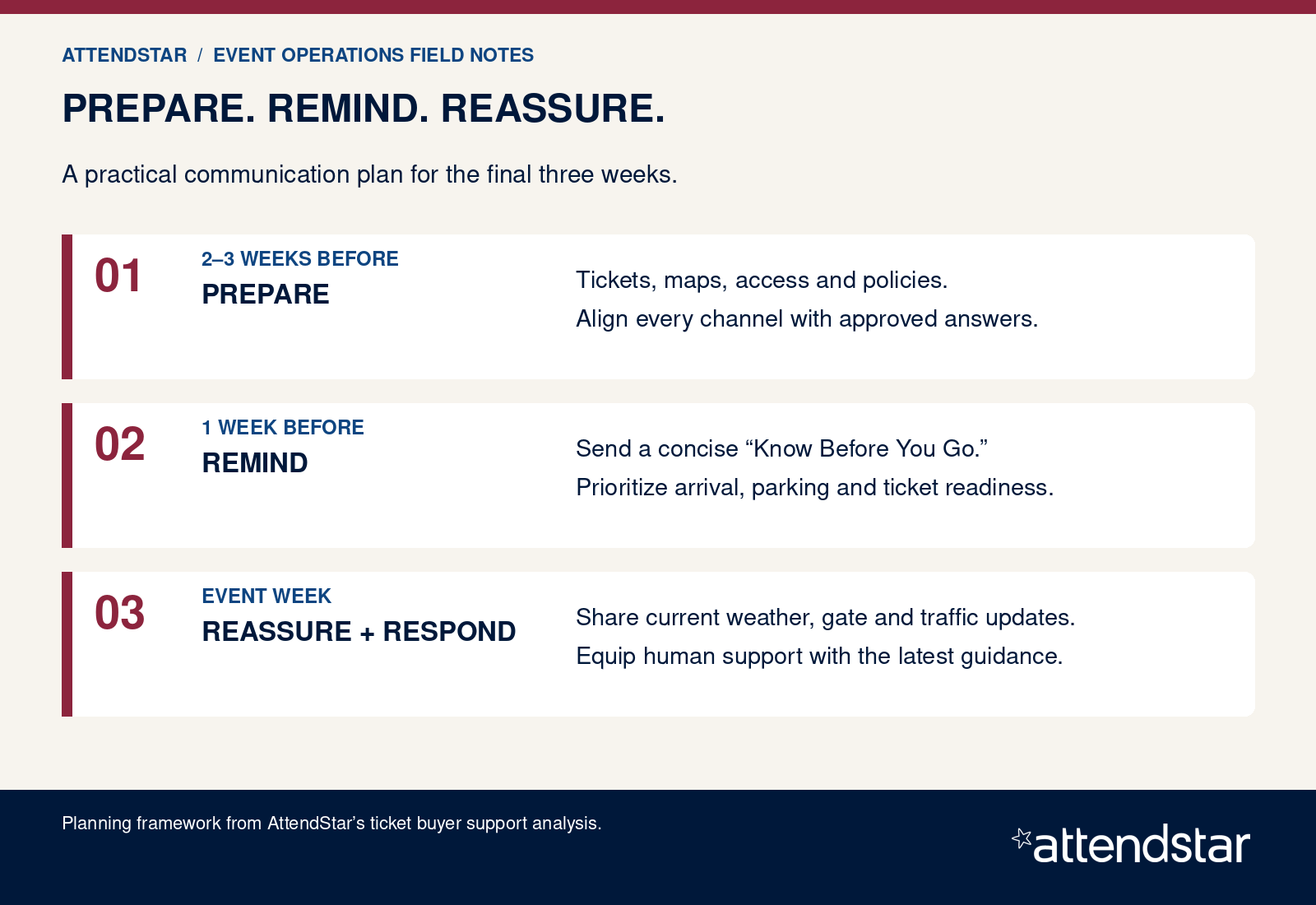
A) 2-3 Weeks Before the Event: Prepare
Use this period to establish the information attendees will need to plan their visit.
Recommended topics include:
- How to access, transfer, save, or print tickets.
- Parking locations, pass requirements, and traffic routes.
- Accessibility services and accessible parking.
- Gate locations and entrance procedures.
- Bag, chair, cooler, food, and reentry policies.
- Child admission rules.
- Refund, postponement, and weather policies.
- Official sources for future updates.
This information should be consistent across the ticket page, confirmation email, event website, FAQ, and support team resources. Conflicting answers create more support work than missing answers.
B) 1 Week Before the Event: Remind
At this point, many buyers are beginning to make practical plans.
Send a concise “Know Before You Go” communication that prioritizes the questions most likely to affect arrival and entry. Do not bury critical instructions in a long promotional email.
The most important details should be easy to scan:
- When to arrive.
- Where to park.
- Which ticket or parking pass to have ready.
- What guests may and may not bring.
- How to get help.
- Where official weather or schedule updates will appear.
Email can carry the complete information. SMS can be reserved for short, time-sensitive reminders and updates when the buyer has provided appropriate consent.
C) Event Week: Reassure and Respond
Event-week messaging should reduce uncertainty, not add noise.
Useful communications may include:
- A final ticket-access reminder.
- A mobile-wallet prompt.
- Updated parking and arrival guidance.
- Gate-opening times.
- Schedule or weather updates.
- A direct link to current FAQs.
- A clear support phone number.
This is also the time to confirm that support representatives have the latest information. A hotline is only as useful as the event-specific answers behind it.
Build a Single Source of Truth
Many support problems begin when information is scattered across too many places.
The ticketing page says one thing. The event website says another. A social post contains an old gate time. Volunteers receive a different instruction. The support team is working from a document that has not been updated.
Before the final communication cycle begins, organizers should create one approved source of truth for attendee-facing information. It should identify:
- The current policy or instruction.
- The person authorized to change it.
- Where the update must appear.
- Who needs to be notified when it changes.
This does not require complicated software. It requires clear ownership and a disciplined update process.
When weather, traffic, or operational conditions change, the same verified information should flow to the website, ticket buyers, support staff, entrance teams, and other public-facing channels.
Measure the Questions, Not Just the Calls
Call volume tells an organizer when demand occurs. Call reasons explain why.
After the event, support contacts should be grouped into practical categories such as:
- Ticket retrieval.
- Parking.
- Arrival and gate information.
- Event policies.
- Accessibility.
- Child admission.
- Refunds or exchanges.
- Weather and schedule.
- On-site purchasing.
- Premium seating or upgrades.
This transforms support activity into operational intelligence.
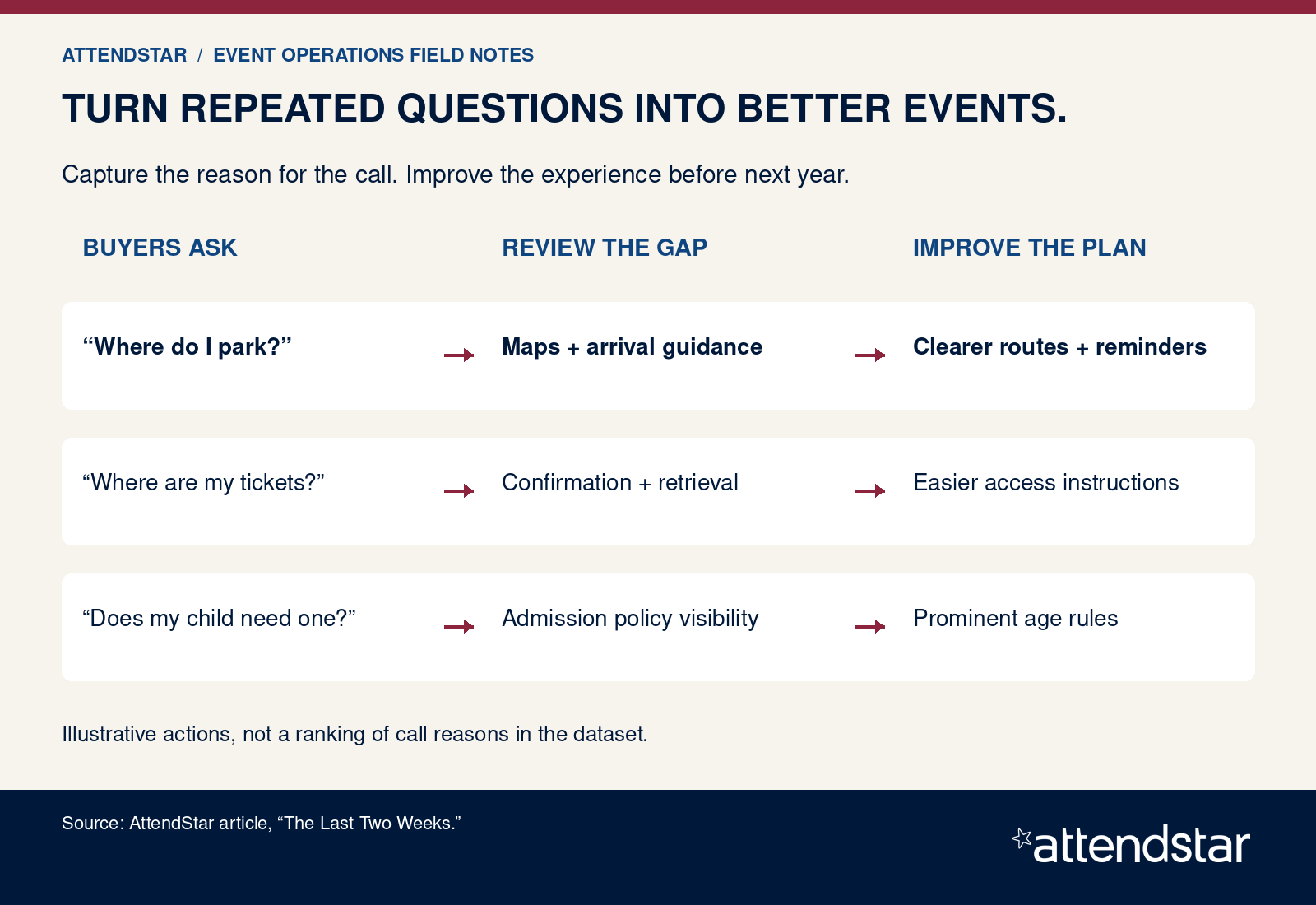
If parking questions dominate, the next event may need clearer maps and earlier reminders. If ticket retrieval is the leading category, confirmation emails and mobile-wallet adoption may need improvement. If buyers repeatedly ask whether children need tickets, the admission policy may not be prominent enough on the sales page.
The best support insight is not merely, “We answered 500 calls.” It is, “We learned why 500 people needed to call, and changed the experience before the next event.”
What This Means for Event Organizers
The data points to five practical conclusions:
- Forecast support as part of event-week staffing. If historical demand concentrates near the event, coverage should reflect that reality.
- Start attendee education before the final week. Waiting until event week means communicating after the support surge has already begun.
- Use advance sales to prepare guests. Every early purchase creates another opportunity to deliver timely instructions.
- Protect access to human help. Self-service should resolve routine needs while people handle exceptions, uncertainty, and event-specific situations.
- Use support data to improve the next event. Repeated questions reveal gaps in marketing, policies, ticket-page content, and on-site planning.
How AttendStar Approaches Ticket Buyer Support
AttendStar treats buyer support as an essential part of the event operation, not simply as order-level troubleshooting.
Our approach combines proactive attendee communication with a custom event hotline and real human support. That allows ticket buyers to get help with the broader questions that affect their experience, including ticket access, parking, arrival, entrances, event policies, weather information, and other event-specific details supplied by the organizer.
The purpose is not to separate ticketing from the event, but rather to connect the two so buyers receive useful answers and the event team can stay focused on producing the event. Because when support demand peaks during event week, availability alone is not enough. Your event support system must be informed, prepared, and built for the realities of a live event.
The Bottom Line
Across nearly 10,000 ticket buyer support calls, the central lesson was not simply that event week is busy. Every event organizer already knows that.
The more useful lesson is that a large share of buyer uncertainty becomes visible at a predictable time. That creates an opportunity to plan for it.
Organizers can communicate earlier, clarify the questions buyers repeatedly ask, connect advance sales to attendee education, provide reliable human help, and prevent routine uncertainty from becoming friction at the gate.
Ticket buyer support is not an isolated service that happens after the sale. It is part of the infrastructure that moves a guest from purchase to parking, through the entrance, and into the event.
And in the final two weeks, that infrastructure matters more than ever.
By the Numbers
- 9,919 ticket buyer support calls analyzed
- 10 outdoor events included
- 54.5% of all calls received during event week
- 64.1% received during event week and the preceding week
- 68.5% received from two weeks out through event week
- 80% of events received most of their calls during event week
- 63% median share of event-week support volume
Source: AttendStar analysis of ticket buyer support calls across 10 outdoor events. Results describe this dataset and should not be interpreted as a universal benchmark for every event; strictly for educational purposes.